 Gulf Today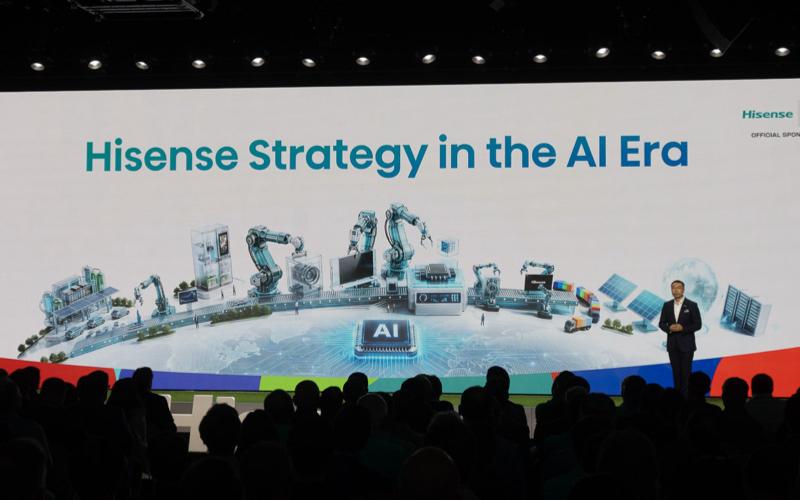
As AI transforms consumer technology, Hisense is looking beyond individual products to build the industrial capabilities, intelligent experiences, and collaborative ecosystems required for long-term growth. For decades, progress in consumer technology was largely defined by the product. Companies competed to build televisions with better picture quality, appliances with greater efficiency, and operating systems with faster performance.
That model delivered successive waves of innovation, but artificial intelligence is beginning to change the unit of competition. Consumers are no longer evaluating devices only by what each one can do independently. As intelligence becomes embedded across the home, they increasingly expect products to understand context, learn preferences, and coordinate with other devices and services.
The question is shifting from whether a product is connected to whether the overall experience feels coherent, personal, and useful. That shift has significant implications for companies. Hardware innovation remains essential, but it must increasingly be supported by a broader system of industrial expertise, intelligent platforms, services, and partnerships.
A successful AI feature may attract attention. Building the capacity to improve and scale that feature across products, categories, and markets is what can create a lasting advantage. The competitive unit is changing At the Hisense Global Partner Conference 2026 in New York, held ahead of the FIFA World Cup 2026TM Final, Hisense set out its response to this changing environment.
The company announced five strategic pillars spanning AI-related industries, intelligent home experiences, long-term sports marketing, service, and global localization. Taken together, the five areas point to a broader transformation. Hisense is not treating AI as a new product category or a software layer to be added to existing devices.
It is seeking to integrate AI into how the company organizes innovation, develops consumer experiences, operates its brand, and works with customers and partners. “As we’ve seen in the last few years, AI is reshaping everything,” said Fisher Yu, CEO of Hisense Group. “And we are all a part of this.” That raises a harder strategic question.
If the next generation of consumer experiences depends on more than a single product, what capabilities must companies build beneath the surface? Industrial depth as an AI advantage Intelligent experiences cannot be sustained through software features alone. AI embedded in physical products requires long-term investment, specialized expertise, and an industrial structure capable of turning emerging technologies into reliable products at scale.
Hisense’s response is its 1+5 industrial framework, developed after three years of strategic adjustment and deeper vertical investment. The “1” represents the company’s foundational business: the evolution of consumer electronics and home appliances into AI-powered devices. The “5” consists of five growth businesses—AI Hub, semiconductors, smart energy, laser technology, and automotive electronics.
“Everything we do in these five emerging sectors is designed to empower our core,” said Yu. The relationship between the established core and the emerging businesses is the central logic of the framework. The five growth areas are intended to create new commercial opportunities while expanding the technologies and expertise available to Hisense’s AI-powered device business.
In return, the company’s established products provide manufacturing scale, market access, and real-world applications that can help emerging technologies move from development to commercial use. This matters because AI leadership in consumer technology is unlikely to come from access to software alone. Many companies can integrate an externally developed AI service into an individual product.
A more durable advantage comes from the ability to absorb new technologies into a repeatable system of development and commercialization. Hisense’s “1+5” framework represents an attempt to institutionalize that process. Instead of treating AI innovation as a sequence of isolated product launches, the company is seeking to build a structure through which new capabilities can be developed, transferred across categories, and scaled over time.
Hisense’s “1+5” framework represents an attempt to institutionalize that process. Industrial depth is therefore not an end in itself. Its value depends on whether those capabilities can be translated into experiences that consumers recognize and use.
From intelligence to experience The commercial test of AI is not how many functions a company can add, but whether technology can reduce complexity, improve relevance, and make everyday interactions more intuitive. Hisense’s AI Companion Suite represents the product layer of this transition. Positioned as an AI-powered home-appliance portfolio, it is built around four capabilities: the ability to sense, think, communicate, and act.
The progression is significant. A connected appliance can receive a remote instruction. An intelligent companion must first understand its surroundings and the user’s intent, learn from previous interactions, and determine an appropriate response.
The shift is therefore from command-based automation toward more proactive and adaptive support. The value lies not in making the technology more visible but in reducing the amount of attention and effort required to use it. V AI OS addresses the content layer.
Positioned as Hisense’s content cloud platform, it is built around four priorities: content intelligence, connected intelligence, natural interaction, and trust. Its role is not simply to aggregate more entertainment. As audiences navigate an increasingly fragmented media environment, the competitive challenge is to make relevant content easier to discover across different sources and interfaces.
As hardware performance improves across the premium market, this surrounding experience—how content is organized, how preferences are understood, and how naturally users interact with the system—is becoming an increasingly important differentiator. ConnectLife provides the ecosystem layer. As Hisense’s AI of Things cloud platform, it is positioned to support whole-home connectivity, cross-device collaboration, cross-brand integration, and synchronization between different interfaces.
The distinction between the three is central to Hisense’s strategy. AI Companion Suite brings intelligence into physical home appliances. V AI OS shapes how consumers discover and interact with content.
ConnectLife enables devices and services to work together across the home. Together, the three offer the possibility of a more coherent consumer environment, in which each product becomes more valuable as part of a system that understands and supports the user across multiple contexts. But creating an integrated experience is only part of the challenge.
For a global business, those experiences must also remain relevant across different markets—and create value for the partners responsible for bringing them to consumers. Scaling value through partnerships The final measure of an AI strategy is whether it can generate durable value beyond the technology itself. For a global consumer technology company, that means improving the consumer experience while also helping retailers, distributors, and other partners grow sustainably.
Hisense’s international development over the past decade provides evidence of the commercial infrastructure behind its strategy. During that period, the company says its overseas revenue increased by more than 300%, while the share of revenue generated outside China rose to more than one-half of the group’s total. Its partner network expanded to three times its previous scale, while its retail footprint grew fourfold.
Scale alone, however, does not guarantee relevance. Consumer expectations, retail structures, and service requirements vary widely between markets. Hisense’s localization strategy therefore combines global technology and operational resources with local talent, market insight, and product co-creation.
AI can strengthen this model by helping the company analyze voice-of-customer information more systematically, identify changes in demand, and bring partners into the product-planning process earlier. In this context, localization is not simply the adaptation of a finished global product. It becomes a feedback loop through which local market knowledge can shape innovation.
Service is part of the same loop. Connected products create opportunities to identify potential problems earlier, respond faster, and use real-world feedback to improve future products. This expands the relationship between a brand and a consumer from a single transaction into an ongoing lifecycle.
Turning these capabilities into sustained market value relies on layered, long-term partnerships—from global intellectual property collaboration to local retail cooperation—that extend reach, demonstrate technological relevance, and drive commercial growth. Hisense’s decade-long engagement with global football offers one example. What began as pitch-side brand sponsorship has evolved toward technological participation.
At the FIFA World Cup 2026TM, the company is serving as the Official Video Assistant Referee (VAR) Review Display Provider, bringing its flagship display technology into one of the sport’s most consequential operational environments. “This is great because to see our partners moving along and suggesting new technology like the cutting-edge LED, and supporting us with VAR operations at every level,” said Romy Gai, chief business officer at FIFA. The partnership gives Hisense a global platform to demonstrate its technical capabilities, strengthen brand credibility, and reinforce its position in the premium market.
At the retail level, Hisense’s long-standing relationship with Australian retailer Harvey Norman offers a complementary example of how collaboration can translate technology into tangible consumer value. Over more than a decade, the two companies have worked together on premium product launches, joint marketing initiatives, and dedicated Hisense Experience Rooms. These spaces do more than display products: They allow new technologies to be demonstrated in an environment where consumers can understand their value more directly.
“Harvey Norman values its partnership with Hisense because of the company’s continued global investment in cutting-edge technology, innovation, and brand building,” said Haydon Myers, executive general manager of electrical at Harvey Norman Australia. “Hisense’s commitment to global premiumization is demonstrated through its partnership across three consecutive FIFA World Cups. That long-term commitment continues to strengthen the brand and creates lasting value for consumers, retail partners, and the industry alike.” Together, the examples point to the broader business logic behind Hisense’s AI-era strategy.
Industrial investment builds the capacity to innovate. Intelligent products and platforms translate that capacity into personalized consumer experiences. Global and local partners then help bring those experiences to market, strengthen their credibility, refine them over time, and generate shared commercial returns.
Artificial intelligence is reshaping more than the products consumers use. It is changing how consumer technology companies organize innovation, translate industrial capabilities into intelligent experiences, and scale their value through global collaboration. Hisense’s strategic evolution represents an attempt to respond across each of these dimensions.
In the AI era, long-term leadership is unlikely to be defined by a single breakthrough product. It will depend on whether a company can repeatedly turn industrial capability into consumer experience—and consumer experience into enduring value. Note: This content was created by Hisense.
Source: fortune.com